
One Year with AI For Developers
A look back at a year of change in AI for software development—and everything else.


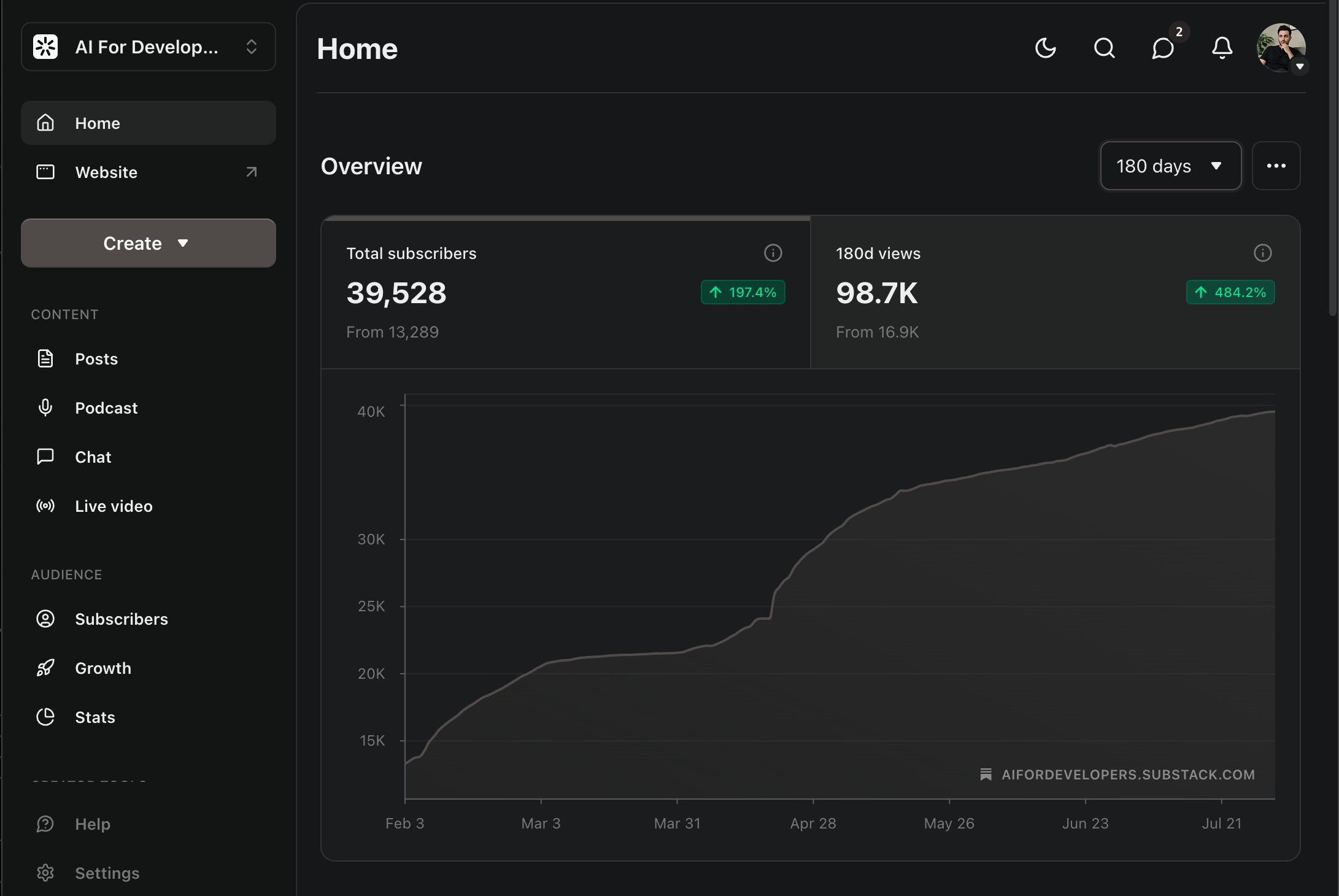
Today is the first day of August. Exactly one year ago, on August 1st, I published the introductory post for AI For Developers on Substack. At the time, only five of my friends were subscribed, and it was hard to imagine that a year later these posts would be reaching more than 39K newsletter subscribers—39,528 to be exact. Even now, it doesn’t quite feel real.
A few weeks ago, Dario Amodei mentioned that Claude had experienced 80× growth, which says a lot about how quickly AI-powered software development is evolving—and how quickly we’ve all adapted to it.
I know most subscribers don’t expect sentimental reflections about the newsletter itself. And honestly, after spending more than 12 years as a software developer, I usually don’t enjoy this kind of writing either. I imagine most of us feel the same way.
Instead, I’d like to spend this post looking back at the past year in AI and software development, and then share my vision for AI For Developers and where I hope to take it next.
Oh—and I almost forgot. My name is Dariush, and this is the first time I’m writing under my own name in AI For Developers. Every previous post has been published under the AI For Developers name, but from now on, I’d like to write as myself.
Just a few days after this newsletter launched—on August 5th last year—Anthropic made its first leap from the Claude 3 generation to Claude 4, introducing the 4.1 family, including Opus 4.1. Since then, the pace of progress has been relentless: Fabel 5, Sonnet 5, and most recently Opus 5. If you ever want a reminder of how quickly things have moved, just go back and try the Claude 3 models again. It genuinely feels like traveling back in time.
We’ve also seen entirely new classes of models emerge, such as Mythos, whose public availability ended up being restricted by governments. Even more accessible models like Fabel 5 have significant limitations in certain domains. One of my friends works in biology and jokes that the model simply refuses to answer half of the questions he actually cares about because of safety restrictions.
At the same time, AI became much more tangible.
I still remember the day OpenClaw was released. Everyone was posting minute-by-minute updates about its GitHub stars. People weren’t just excited about another open-source project—they were excited because it introduced a genuinely useful new way of working. And it delivered.
My friends were buying Mac minis just to run OpenClaw locally, while RAM prices seemed to climb higher every single day (and they still are).
For me, though, this wasn’t really the year of agents—it was the year of skills.
We’ve seen so many incredible skills built over the past year, and virtually every coding tool has added first-class support for them. I honestly think skills represent the beginning of a much better way to make AI genuinely useful for developers.
New capabilities like Claude Design have also changed the way I work. I’ve moved several of my personal projects over to it—although patience is still essential whenever you’re building something outside your comfort zone.
There was a time when AI-generated images were easy to recognize. Today, it’s websites built entirely through vibe coding that have become instantly recognizable.
So much changed over the past year.
OpenAI has been pushing hard to compete with Claude. I spent some time trying Grok Build and was pleasantly surprised by it, and the Chinese models have been impressive as well. Last year I expected models to become significantly more capable, but I honestly didn’t expect models like Kimi K3 and the DeepSeek family to remain this competitive. Yet they continue to surprise us almost every day. If hardware weren’t such a significant bottleneck, I think we’d be even more amazed by what these models could achieve.
When I started AI For Developers, Cursor was still my primary tool. Today, as I write this, Claude Code has long since become my only daily driver. It feels like home.
Running out of tokens has forced me to give other tools plenty of opportunities, but Claude Code still works better for me than anything else. Maybe other models would have a better chance if I could use them directly inside Claude Code—I experimented with DeepSeek for a while because it exposed Claude-compatible endpoints. Codex, on the other hand, gave me one of my worst developer experiences because of its /usage output. I’ve become so accustomed to constantly monitoring my usage that I simply didn’t enjoy using it enough to continue. I’m sure there are ways to improve that experience—I just haven’t looked into them yet.
Overall, this has been an incredible year for AI-assisted software development.
We’re finally at the point where it’s possible to build real, reliable software with these tools—especially if you’re already a solid engineer, know your stack well, understand concepts like Skills, MCP servers, and the fundamentals of modern AI tooling, and perhaps most importantly, have patience.
One lesson I’ve learned is that when you delegate work to AI out of impatience, things usually fall apart. But when you work with it patiently and collaboratively, development becomes dramatically faster, the results are better, and the software is much more likely to remain maintainable over the long run.
This year we’re planning to significantly improve the AI For Developers website, making it much easier to learn about AI concepts, compare models and tools, discover new workflows, and find developer-focused educational resources. I think we’ll be able to ship those improvements fairly quickly while continuing to build a stronger AI For Developers community.
Before I wrap up, I’d love to hear from you.
Looking back over the past year, what breakthroughs or changes stood out the most to you? What did I forget to mention?
Let’s talk about it in the comments.
Lots of WordPress websites look the same as well. AI / vibe coding websites are really how you prompt and execute in the creation.
I think OpenCode is growing so fast and have a bright future!